


Tilly Scantlebury of Lazy Day Talks About ‘Open the Door’

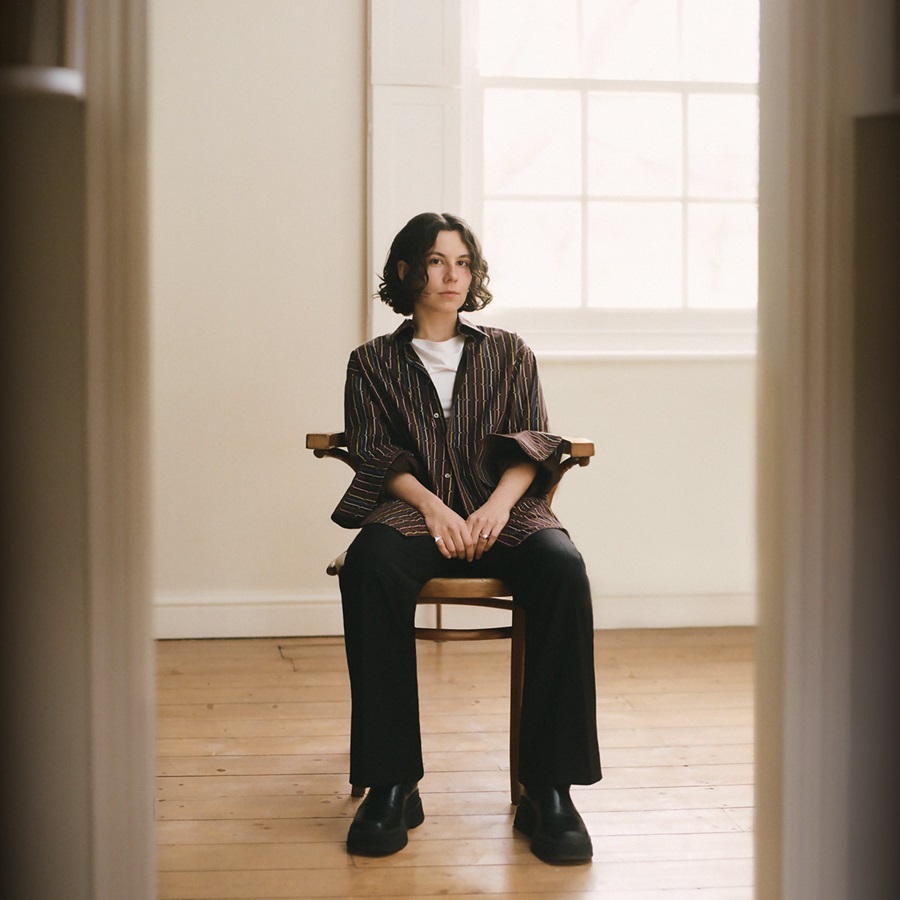

Open the Door, the debut album from art historian and musician Lazy Day (aka Tilly Scantlebury), is a smash hit. With songs like the infectiously dazzling headbanging 90’s rocker “Falling Behind,” the beautifully pensive “All The Things That I Love,” the strangely groovy and eerie “Killer,” and the hopefully upbeat and comforting “Bright Yellow,” Lazy Day’s Open the Door is a sensational debut.
How the Album Came to Fruition
Scantlebury was writing Open the Door at the same time they were finishing their PhD. “Writing an album and writing a PhD were odd bedfellows, but they were actually super productive side by side, even though that sounds a bit weird or strange and a big undertaking to do those two things that I’ve wanted to do for so long,” they comment. “When I was tired of researching or writing, I would pick up a guitar. Or when I was frustrated with a lyric, or I couldn’t get the drum sounds quite right, I would go to the library where I would look at artwork. It actually gave me a lovely push and pull between these two worlds I initially thought were very separate, like Tilly, the musician and Tilly, the academic or art historian. What was really cool about it was, it showed that I could be everything all the time.”
Choosing the Title
Open the Door comes from a line in the song “All The Things That I Love.” Regarding the line opening up the song: “We got tired of waiting / You opened the door / I did all that I’d said I’d do before” Scantlebury reflects, “It’s about my wife kind of pushing me to say, ‘Come on. This door’s open now. You got to get through it.’ It’s about love and confidence and encouragement but it’s also a partnership that requires to change; it requires something of you and demands something of you in an amazing way.”
Scantlebury was also fascinated that the sentence ‘Open the door’ can have many meanings. “It can be an invitation like, ‘Open the door.’ It can be demanding, like, ‘You better fucking open that door.’ It can feel capacious and hopeful, but it also reminds me of the times the door has been slammed in my face. I think I arranged the songs in a way that some of them are about stepping through, and some are about being shut out. At the end, I hope I step on through.”
Big Life Changes and Evolving as a Musician
Looking back at their earlier EPs and singles compared to their debut album, Open the Door, Scantlebury finds they have grown quite a bit. “In a way, I didn’t have the same self-knowledge or confidence,” they say. “I came out as nonbinary two years ago, an amazing thing to finally arrive at yourself. I got married a year ago. I turned 30 nearly two years ago. I got my PhD. Since that time of the last release, so many transformative things happened that make you happy that you got through it and excited for what’s to come.”
Open the Door also marks the first release which Scantlebury calls a solo project. “Even though nothing had changed in that I had always written the music, and I had always written the lyrics, I never sort of said it was a solo project,” they state. “I always kind of said it was a band. That’s fine and good, and I love my friends that are playing with me, but that’s not true. It wasn’t a band. It’s never been a band. It’s kind of like Lazy Day is Tilly. It’s like a pseudonym or moniker. Another big change is, I feel confident or happy enough to own whatever I’m making, which is a big relief.”
The Creative Process
Scantlebury shares a bit about the writing process and how they came up with the instrumentation for a few songs from Open the Door.
Bright Yellow: Scantlebury was incredibly excited about the writing process and theme for “Bright Yellow.” “It’s about a photographic series from the ‘90s made by someone called Catherine Opie, and it’s about these queer people, these amazing photos of queer people wearing fake moustaches looking out at us,” they exclaim. “It’s called ‘Being and Having.’ It’s a wonderful piece of work. They’re against these bright yellow backgrounds. I wrote about this photo series in my PhD. I remember seeing this series and thinking, ‘Oh my God,’ like feeling known or feeling like we were looking at each other, all these 13 people and me.”
“That was a song that was really about something I had written, that was a whole chapter, like, 20,000 words, and I had looked at these people for so long that I felt like I knew them. I felt so happy and excited by them. I kept imagining them dancing, being in the club, and then I was thinking about synth sounds and Robyn, and I was thinking about partying with all of them.”
“It started off as a quiet and minimal song, but I just got too excited thinking about all these people and what they would be doing in the ‘90s and how much fun they would be having, and actually, it started to become an upbeat song and a more hopeful song because of my feelings about these people and what they made me feel.”
Falling Behind: Scantlebury incorporated palm muting on the guitar for “Falling Behind.” It was also one of the first songs that they wrote for Open The Door. “I have a whole run of voice memos that I made that tell the story of how I made it,” they note. Like ‘First verse idea.’ Then, like, 20 minutes later, ‘Chorus melody idea.’ Then, the next day, it’s like ‘Second verse idea.’ Then, the next day, ‘Showing the band the new song.'”
Sonically, bands like Garbage and Elastica were huge inspirations for “Falling Behind.” “When I came to recording in the studio, I needed it to reach that very logical, breathy ’90s conclusion,” explains Scantlebury. “It had to have that. Even when I sing in that recording, I try and channel that cause’ that’s the music I really grew up on. In the chorus, there’s, like, two of me, like, there’s two main melodies that come together. The bit that was hard about that song was the bridge because I didn’t have a bridge for ages. But then I started playing a very strange but groovy bass part.”
Getting Good: With “Getting Good,” Scantlebury decided to change things up a bit. Most songs that they make the guitars are usually in standard tuning. However, for this song, they decided to experiment with DADF♯AD. “You’re kind of out of your comfort zone, but not in an uncomfortable or scary way, but it kind of frees you from normalcy,” they comment. “You kind of don’t have expectations of yourself because the bar is quite low. I’ve never been in DADF♯AD before, which meant I could just feel it out. The song is about getting quite good at habits that aren’t good for me personally. But I just loved how the guitar sounded. I don’t often get nerdy or enamored about guitar, even though that’s, like, the main instrument I play live. I’m way more nerdy about drums and bass, oddly enough.”
Killer: “Killer” started instrumentally with a drum loop that Scantlebury found and absolutely loved. “I changed the BPM, chopped it up, and made this very strange but very exciting loop,” they reflect. “I remember I bounced it out on GarageBand, and I had it as an MP3 and put it on my phone and put on my headphones, and the way home, I was like, ‘Woah,’ and I could just hear it all going. That song started with the drums sonically. I already had the theme in my head but didn’t have the music. I think it also shows how rhythm is so influential in this record because I often started with drums or wanted the bass to have a strong tempo that drags you through the song.”
Scantlebury wrote “Killer” after binge-watching Hannibal but also pulled a little from their own life. “What I was interested in is the two main characters Hannibal Lecter, the famous cannibal, and Will Graham, this detective trying to find him; they obviously love each other,” they say. “They’re terrified of each other but also love each other. I was basically thinking, ‘Wow. This is so gay.’ It’s not explicit, but other people online, as online often is, like, there are subreddits and fandom stuff, and lots of fans are like, ‘This is the gayest thing I’ve ever seen.’ I was really interested in that, this kind of love/hate dynamic.”
“Obviously, Hannibal is eating people, but I was reading it as to be hungry for someone. I was abstracting that idea of eating, having an appetite for something or someone, and that’s where I took it in my head. Then I was thinking about being with my wife, who actually wasn’t my wife at the time. I was thinking about how desire is a fueling of an appetite that is already there, and actually, when you’re in sync with someone, appetites grow together, and that’s an amazing, wonderful thing. It can be mysterious or out in the open, but either way, I was really excited because I had never written from a fictional perspective.
“What ended up happening is that it merged with my real life and made me think being an artist is often about searching for what you need in other forms of art. You’re kind of a detective when you’re an artist. You’re like, ‘What can this do for my imagination?’ That’s what Hannibal did for me. I was obviously hungry for seeing queerness into something that maybe wasn’t there. But I loved doing it. I loved the mashup of fact and fiction.”
“I often think, ‘Ah. I wish I had written that song’ about other people’s songs, which is such a silly thing to say because I didn’t write it, and why am I getting sad about not writing a song? But I think if I heard “Killer” and it wasn’t my song, I would think, ‘I wish I’d written that song.’”
Strangest Relief: “Strangest Relief” is one of Scantlebury’s favorite tracks from the record. “That is maybe one of the best songs I’ve ever written and is quite unassuming, which I quite like,” they state. “My Mom also really loves that song and cries every time. She’s quite a hard judge as well, but a great judge.”
Earning a PhD, Being An Art Historian, and Studying Feminism and Queer Theory
Along with being a musician, Scantlebury is also an art historian. Their love for art started when they were a teenager. “I went to a school that offered art history when I was 16, and I immediately became just amazed that you could learn about why someone made something,” they comment. “So I went to university, studied it, and was good at it. Then I wanted to do more, So, I did a masters and thought there’s still stuff I need to say that hasn’t been said. Doing a PhD is very, very hard. I mean, 1,000,000 words is a ridiculous amount of words, especially for someone who’s dyslexic like me, but I knew that I could bring a big idea to life.”
Judith Butler is one theorist who Scantlebury researched lots for their PhD. “Judith Butler has really changed the formal composition of my brain,” they smile. “What I love about art history, queer theory, and feminism is that ideas build and build and build. So, you probably couldn’t have had Judith Butler if you didn’t have Simone de Beauvoir. Same with music. You probably couldn’t have had ‘Falling Behind’ if you didn’t have Garbage or Elastica. I love that history of where ideas come from, how we evolve and change, how ideas build on each other, how knowledge accrues over time, and how we change with those ideas.”
“I think when you make art you want to be in some small way part of a conversation you find value in. That’s what I did with my PhD. With my PhD it was, ‘Can I contribute meaningfully to this conversation? What new things can I research that I can bring to the table?’ I think when you make a record, it’s not dissimilar. You’re thinking about your influences, what you want to say, and you’re hoping to present something to the listener and ultimately have a conversation with your listener that you have no idea who they are but maybe one day you’ll meet at a show, or they’ll message you. I think that desire to reach out and be part of something that you’re excited by, for me, is what it’s about.”
Scantlebury loves art of all kinds, but visual art, in particular, really inspires them. “I find visual art propels me forward; it makes me think differently about the world, who I am, and my place in the world,” they state. “I think feminism and queer theory are two amazing political theoretical tools. It’s like putting on different glasses and literally changing the way you see something. I was really excited about that and still am. It’s my day job. I’m an art historian by day.”
After Scantlebury finished their PhD, they realized, “Nothing’s ever just theoretical. It’s about the way you live your life or want to live. Artists who did amazing work and changed the landscape or changed how people see themselves is so brave. That’s incredibly brave and admirable. That made me want to be as true or brave as I could as a musician. That’s probably the single most important thing that great art can teach you, like, ‘You got to do it.’ Wanting to be like them. That’s the most childish but true way I can say it. When you really admire other artists, you just want to be as rockin’ as them.”
Concluding Remarks
Overall, Scantlebury hopes Open the Door can provide listeners with many things. “I hope it makes them feel like they want to be part of the conversation about being queer or living queerly or that you’re open to changing who you are or how you feel. I hope it feels really warm to people. I think that was a big thing for me in the production. I wanted it to feel warm. I wanted it to feel like you could imagine me playing all of it. So it’s like an invitation. I want people to feel part of it in their ears, but warm also in a way like I wanted it to be generous. I gave as much as I could. I hope it makes people feel, ‘Yeah. I’m gonna walk through that fucking door!’”
Upcoming Lazy Day Tour Dates:
February 6th at in Manchester, UK at YES (Basement)
February 7th in Glasgow, UK at Nice N Sleazy
February 8th in Edinburgh, UK at Sneaky Pete’s
February 13th in Bristol, UK at The Louisiana
February 14th in London, UK at The Lower Third
Buy Open The Door here, or stream the album here.
Follow Lazy Day on Facebook, Instagram, or X (Twitter).

