


Kerrie Joy is Charismatic Magic


It’s not fair to say that Kerrie Joy is just a storyteller, for she is an imaginative, sensory orator who paints vivid pictures with her words, transporting the mind and opening the soul. It’s not right to say that she is just a performative poet and savvy songwriter, although she does spit prolific rhymes which are capable of redesigning sensibilities. It’s not right to deduce Joy to but a clothing designer, for her technique in approaching formulas of cloth and stitch are derived from internal identity and external purpose. It’s not expansive enough to call her just a cannabis consumer and activist, for her queerness and Blackness inherently draw from millennium of prejudice, oppression, and stigmatization, carrying the burden of every move being deemed a political statement. It would also not be far-fetched to claim that the writer, artist, sonnetist, designer, and activist is a reborn rhapsodist, and a versatile visionary.
Looking at where Joy has arrived in life, a successful entrepreneur who is married to political standout Candi CdeBaca, one would likely assume that a dive into her personal history would not be one of turbulence, turmoil, and internalized self-redaction. However, her rise to stardom came with myriad obstacles and friction.
Raised by two, hard-working Jamaican parents in Brooklyn, NY, she and her family dedicated their lives to the strict, Christian philosophy of the Apostolic church that adheres to literal, Biblical principles.
“I’m a proud, Black, queer woman living in a world where it’s hard to be fully human in public,” Joy explains. Elaborating, she says, “I feel like that’s something that I’ve wrestled with my whole life. Growing up in a very legalistic household, it was cultish in some ways, being a queer woman, there was absolutely no space for that. On top of that, being a Black woman in the world and knowing what that meant, it’s taken me a very long time to get to a place where I am no longer sorry for existing as I am.”
Related article: Repairing the Damage in Two Acts
Tiptoeing the line of divinity and authenticity, Joy often suppressed her truth in order to be deemed lovable and acceptable to God. By denying herself of the wants and desires of the flesh, and attending church obligations no less than four days per week, Joy found that she was being stripped of her unique, strong, empathic essence as she strayed further away from herself and closer to what others wanted of her.
“There’s a verse in the Bible that says, ‘Obedience is better than sacrifice,’ and I still don’t completely understand the context in which it was used, but the understanding of obedience was really, really ingrained into me and my identity,” Joy admits.
“Sometimes I feel a lot of shame and guilt, to be honest, about allowing myself to be in that space and to be subjected to that kind of oppression for so long. I consider myself an intelligent woman and get frustrated at how long it really took me to step out,” she confesses.
After being challenged by an English teacher in 11th grade, Ms. Jennifer Costabile, to paint a picture with her words, exploring the usage of colorful language, and trusting her instincts, Joy discovered refuge in the art of storytelling. This opened her eyes to new ways of existing freely and set her down a path that would forever change her.
“That’s really where I just would allow myself to be as real as possible. There was a point in time where a lot of the internalized hate came out in my journal, too, and I feel like I see the transition and growth over time,” she says. “Still today, that’s literally one of the only ways that I’m able to really sort through the thoughts in my head and deal with the ways of our world.”
It wasn’t until Joy married a man that she fully realized that she was making herself miserable by living a life of self-denial. Existing daily with the weight of the lies, and experiencing depression and suicidal thinking, it all became too exhausting and she decided to walk away from everything she ever knew.
“I just took a chance on myself, and was met with some backlash, you know what I’m saying, but it was all worth it. This is the life that I believe is worth dying for: being authentically me.”
Relieving herself of the pressure put on her by her church, and the nagging criticism of that leadership team, Joy flexed her strength and unapologetically pursued her passions. Applying her once-religious obedience to an entrepreneurial discipline, her determination shines through in every artistic endeavor she takes on.
Joy is fiercely and incredibly effective in her efforts as she persistently links her personal interests to how they effect the collective community. Having moved to Denver in 2017 to start her life over as an out, queer woman, she has quickly become a celebrated, public figure and a creative factotum.

Taking the role of an instructor and educator, Joy teaches young folks to trust their inner voice through workshops and motivational speeches, and she performed on stages of the 2018 Womxn’s March, TEDx Mile High, and Red Rocks Amphitheater, to name a few. She is a community educator around public policy and local campaigns, partnering with Ru Johnson on the DeMystify the Technique initiative that unveils what’s going on behind the scenes in local legislation. She is the co-executive director of The Kaleidoscope Project, a nonprofit that aims to activate collective power in BIPOC communities through social engagement, grassroots organizing, and cultural fortitude. Joy is also a co-host of The SIP Podcast, where three Black women in the arts invite listeners into the “sister group chat,” sharing their journeys, truth, and power.
Additionally, Joy is a clothing designer, branching out and exploring the various identities which are housed within her. From the Kerrie Joy line, which encourages folks to be bright, colorful, and vibrant, carrying joy to all those around, to the Assata Forever tribute, which pays homage to Assata Shakur, who’s activism and revolutionary spirit has been an inspiration to Joy. She also developed the East Side Forever line, which honors the original, non-gentrified communities of color in Denver.

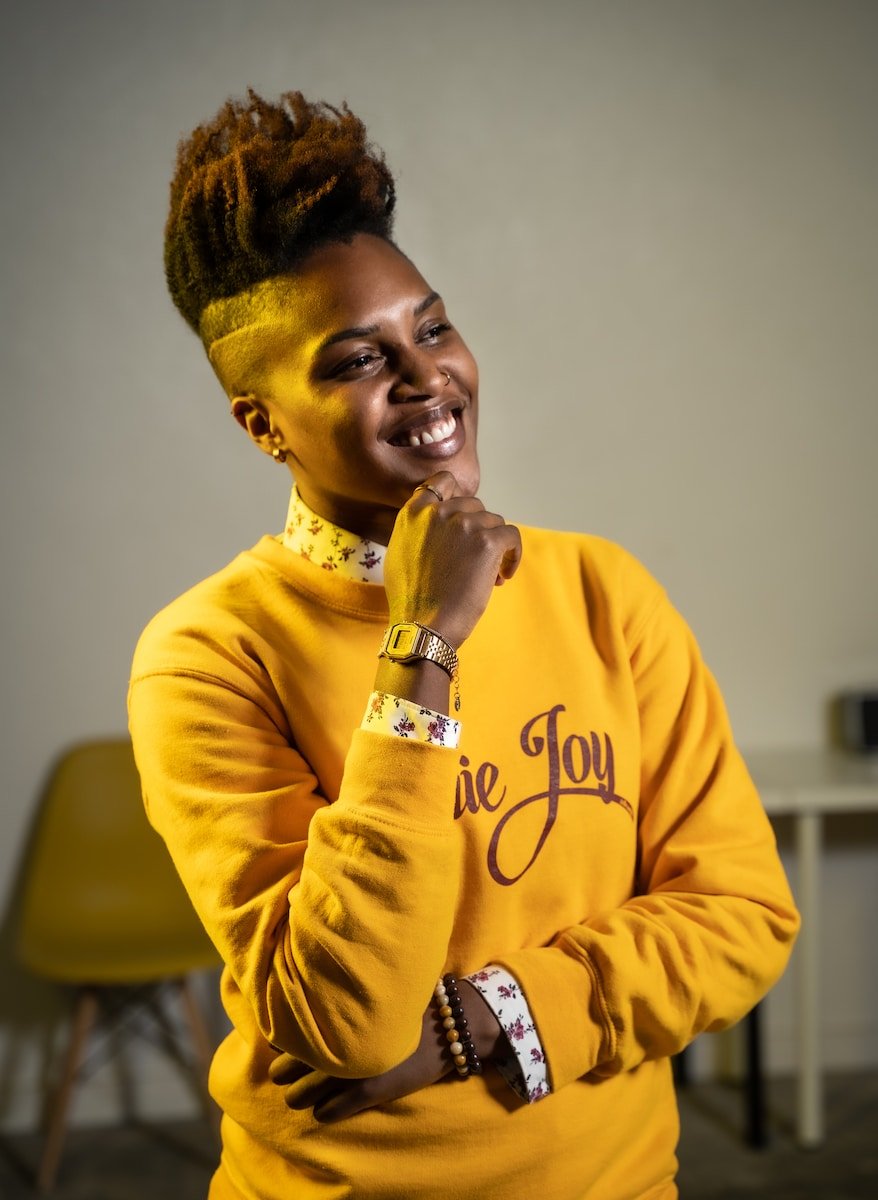
Photographer Julius Garrido was eager to connect with Joy, excited to capture the determination, power, beauty, and spirituality that she exudes in every movement and project. He describes her presence as strong and her suave aesthetic as the personification of beauty.
“She’s beautiful, yes, but she has this androgynous mystery, like, what kind of aura is she trying to convey? There’s a mystery within, the kind of energy that is masculine and feminine. She’s like a chameleon, she keeps changing,” Garrido explains. In order to highlight the message of ambiguity and change, he utilized a black background and bright, colored gels on the lights in order to accentuate her dark skin tone and call attention to the duality and dimensions within her.
As the two collaborated during the photoshoot, they also discussed the experience of being immigrants in the United States. Garrido being from the Philippines and Joy being raised by Jamaican parents, they connected on the feelings of being outsiders. That connection, that shared tenacity, created a safe space for the two to explore the diverse nature of Joy’s personality, creativity, and curiosity.
“To be honest, I was kind of like, I wouldn’t say starstruck, but I was thrilled about the shoot. She projects that kind of celebrity aura. She knows what she’s doing, and she’s front-page material. When I met her, she so nice and so wonderful, and so down to earth; she’s just a pleasant person to work with,” he explains.

As a curious, creative soul, Joy tells the details of her story willingly, knowing that shared experience often is a vehicle to empathy, understanding, and progress. She feels that living in her truth encourages all of us to recognize what we have in common. Through the awareness of shared pain, and being unafraid to call out the systems which do not serve the collective, she hopes to help create a world where we are able to mitigate the trauma, and heal.
“I always say that storytelling is an opportunity for solidarity. You know, we wear a lot of masks, and it makes it really, really difficult to connect on a deeper level and understand our shared struggles so that we can decide how to collectively fight for each other,” Joy says.
The diligent obedience and discipline instilled in her during her upbringing steered Joy away from partaking in anything that would alter her state of mind, like alcohol and drugs. However, she began applying her once-religious convictions to an absolute conviction of pursuing every endeavor that is of passionate interest. She began using cannabis in her early 20s, and while the initial experiences brought guilt and fear of consequence, she was ultimately able to find a space in which she could savor it and enjoy the ride.
“I haven’t been consuming for that long, but it has definitely transformed my life for the better. When I allowed it to help me calm down, it really did bring the sense of relaxation; everything became more colorful, and everything became more beautiful in the world,” she explains. “Over time, it has become something that I feel really helps me tap into all of the talents of the universe in a different way. Tap into my ancestors in a different way.
“I’m Jamaican, man, and this is something that my people did to reason with each other. That’s what they call it, and to just sit down and have these conversations about life and what’s going on in the world, to let your guard down so that it can be more authentic.”
Related article: Vivek Shraya Redefines Failure into Fierceness
Joy uses an assortment of cannabis products while maneuvering throughout her various creative projects, with each variety and strain serving a specific purpose. Preferring to use a 1:1, CBD to THC edible when she’s singing or performing on stage, calling out DOSD and WYLD as her favorites, she is also really drawn to the tinctures by ConsciousMEDZ.
“If I am smoking, that Cherry Gelato Cake is everything. I’m an indica lover, and that takes me exactly where I need to be to relax,” she says. “If I do need something to give me a little bit of energy, I go with the Golden Goat. Like, if I need to work, if I need to really get into a space to potentially write, or if I’m like building garden boxes outside, that gives me that energy.”
Preferring an indica when she is performing, because it gets her out of her head and into her body, Joy typically will rely on a sativa when she needs to activate creativity and imagination, such as songwriting or clothing design. She describes it as opening space and accessing a new portal to travel within herself that is purely uninhibited. Acting as a vehicle to travel to different memories and internal places, she can imagine different futures and different realities and is a sure way to get her into that creative space.

“The fact that cannabinoids already exist in our body, and it’s extremely healing to our bodies. I think we can be intentional about it being a spiritual part of our lives. A lot of people are genuinely using cannabis as a tool to journey with themselves, with their ancestors,” she says. “That type of understanding of spirituality has been demonized over time; we definitely need to revisit those conversations with people and teach people that it is a very layered journey. It’s physical; it’s emotional; it’s mental, but it’s also extremely spiritual as well.”
For an out, Black, queer woman who openly uses cannabis to exist in this country unapologetically and vocally in and of itself is a political statement. Being a person who uses their platform to further the conversation of systemic inequities within the current social and legislative climate is defiant by nature. To actively demand better from the resentful legislators around community engagement and governmental transparency is considered problematic in the civil sphere. And while all these things may be true, it doesn’t stop Joy from suiting up, showing up, and speaking out.
“We’re not doing enough as a society; we need to reckon with that because there’s so much blood on the hands of the U.S. government specifically. The blood of our people—Black and Brown folks, Indigenous people—there’s so much harm that needs to be repaired,” she says. “The fact that we still have folks locked up nationwide for marijuana offenses is unacceptable. Everybody that has a nonviolent marijuana offense needs to be released immediately; their records need to be expunged immediately. Folks that have a violent marijuana offense, I feel like their cases need to be revisited to understand the context of what happened. Maybe their sentences could be reduced; maybe it can be time served; there’s just so much that we need to do to give people back their lives.”
Looking up to people like Ru Johnson, and her wife, Denver City Councilwoman Candi CdeBaca, Joy remains active in her support of their equity work, in the cannabis space and beyond. Joy sees what is happening in the communities that house grow facilities, and her very own neighborhood is overwhelmed by them. The white-dominated industry is making money on the behalf of Black and Brown folks rather than alongside them, she explains.
“I know (cannabis) saved my life in many ways, and as a community that has been oppressed and traumatized over time, it has been a tool to cope,” Joy says. “When it comes to the Indigenous community, we’ve got to give land back, man. In Swansea, we have the highest concentration of grow houses in our communities, but no access to the wealth that has been accumulated in this space. All this pollution, all of this water waste, and we still don’t have access to running our own greenhouses … It’s unacceptable.”
Finding different opportunities to challenge the systems that oppress is not difficult, for there is an abundance of issues within the layers of government, Joy still finds ways to bask in what’s good. While many conversations over the dinner table with her wife, CdeBaca, may center around the ways in which they can serve their communities, they are innately dreamers and use their collective imaginations to inspire positive action, such as staying in love with creativity, and each other.

“I’m currently working on my first album, and I am really challenging myself to sing more, so that is a very vulnerable space,” Joy says. “The first song I hope to release next month is called ‘Magic,’ a love song that I wrote to my partner, to my wife. I told myself that I want my first few songs to be about love. A lot of times when I’m in spaces performing, I’m talking about a lot of heavy things, and it’s important to hold space for those conversations, but there’s so much joy in my experience as well. There’s so much love and so much happiness to unpack, too.”
There is a plethora of ways in which Kerrie Joy may grab your attention, from her words, to her art, to her activism and civic engagement, There is an undeniable magic that lives within her that is charismatically and authentically pure. When daydreaming about a community that works together, uplifting those in need and celebrating those who unselfishly contribute, it’s easy to imagine Joy as an integral part of the founding collective of an infrastructure that is equitable, mindful, and sacred.
*Photos by Julius Garrido
What's Your Reaction?

